An editorial by Gregory Isaac
Views are the author’s.
Every time California High-Speed Rail comes up online, somebody eventually says the same thing:
“It’s a failure.”
Not that it’s behind schedule.
Not that it’s over budget.
Not that it’s been poorly managed.
A failure.
Complete. Total. End of discussion.
And every time I hear that argument, I find myself wondering whether we’re talking about the same project.
Because I don’t see how anyone can look at California’s transportation challenges and conclude that a statewide high-speed rail network is a bad idea.
I see crowded airports.
I see congested freeways.
I see housing costs forcing people farther and farther away from the places where they work.
I see a state that has stretched beyond the transportation systems built for it decades ago.
And I see a project designed to address many of those problems.
California High-Speed Rail isn’t a bad idea.
It’s one of the most obvious transportation projects California could build.
The real problem isn’t the railroad.
The real problem is California’s inability to build it efficiently.
Those are not the same thing.
And if we’re going to have an honest conversation about high-speed rail, we need to stop pretending they are.
The Project Is Not the Same Thing as the People Running It
One of the most frustrating aspects of the debate is the assumption that criticizing how the project has been managed somehow means opposing high-speed rail itself.
It doesn’t.
I support high-speed rail.
I do not support bureaucratic dysfunction.
I support connecting California’s major population centers with fast, reliable passenger transportation.
I do not support years of delays, political indecision, regulatory paralysis, endless studies, endless lawsuits, endless revisions, and endless excuses.
I support the destination.
I am deeply frustrated by the journey.
Far too many people have convinced themselves that because the execution has often been poor, the underlying idea must also be poor.
That’s nonsense.
If a contractor does a bad job building a house, that doesn’t prove houses are a bad idea.
It proves you hired the wrong contractor.
The state’s inability to build infrastructure efficiently is an indictment of the state’s management, not an indictment of infrastructure itself.
Why California Needs High-Speed Rail
California’s transportation challenges are not getting smaller.
Our major airports are finite.
Our freeways are finite.
Our urban footprints are finite.
Yet the demand for mobility continues to grow.
A functioning high-speed rail network would create enormous benefits.
It would provide a competitive alternative to driving between major regions of the state.
It would free up valuable airport capacity at places like LAX and SFO by reducing demand for short-haul flights.
It would create stronger economic connections between regions that are currently isolated by distance and congestion.
Perhaps most importantly, it could help address California’s housing crisis.
A truly fast transportation network changes geography.
If reaching a job center becomes dramatically easier, people gain more flexibility in where they choose to live.
Communities in the Central Valley become more accessible.
Housing demand becomes less concentrated.
Economic opportunity becomes less tied to a handful of expensive coastal ZIP codes.
None of these effects solve California’s problems by themselves.
But they help.
And transportation projects don’t need to solve every problem to have value.
They just need to make things better.
As a railfan, I’ll happily admit one more reason I support the project:
I think it’s cool.
America should be capable of building ambitious rail infrastructure.
California should be capable of building ambitious rail infrastructure.
There is absolutely nothing unreasonable about expecting that.
I Don’t Want to Take Away Your Car
One of the strangest assumptions in transportation debates is that supporting rail somehow means opposing automobiles.
I don’t.
I drive.
I use freeways.
I use airports.
I think autonomous vehicles are one of the most exciting transportation developments in decades.
What I want isn’t fewer transportation options.
I want more transportation options.
Transportation shouldn’t be treated like a religion.
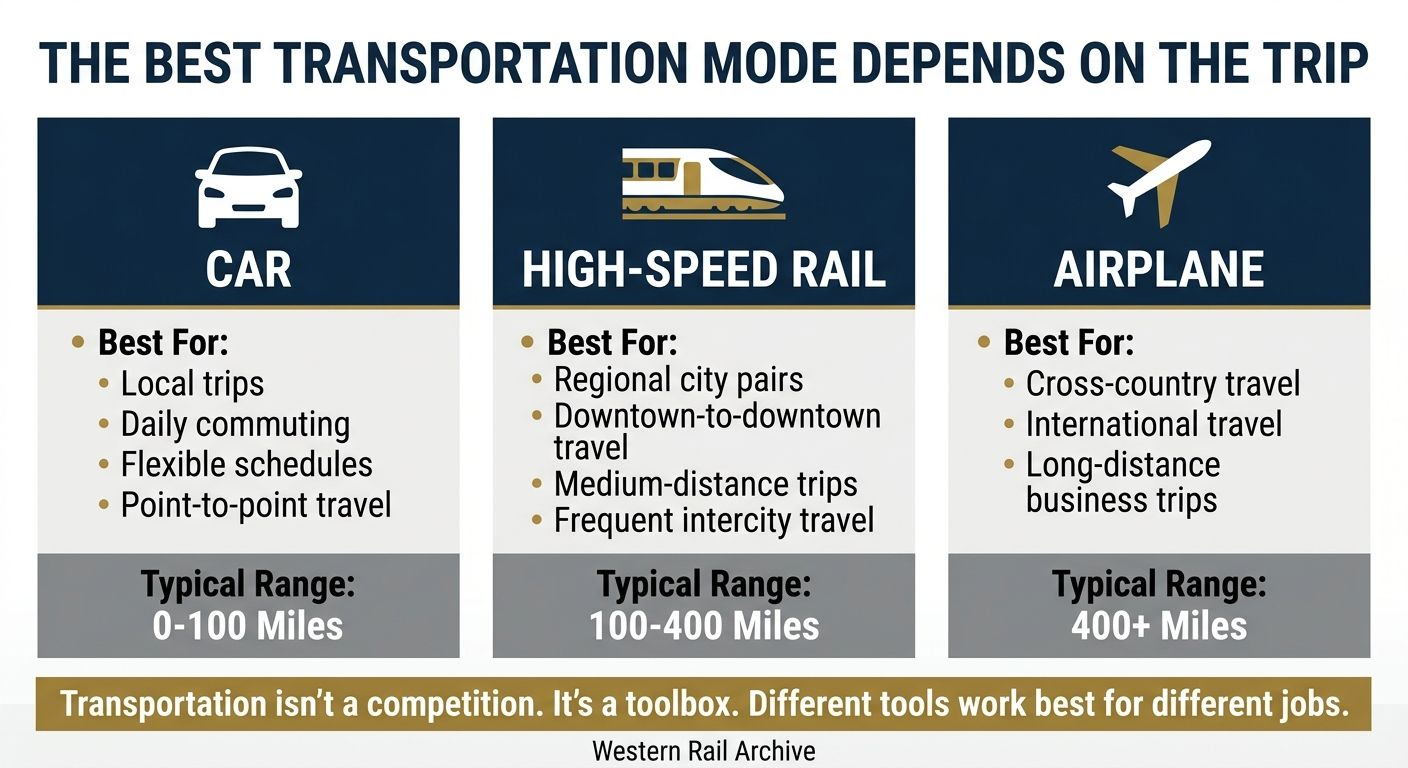
It’s a toolbox.
Different tools exist for different jobs.
If I’m driving to the grocery store, my car is probably the best option.
If I’m flying from Los Angeles to Tokyo, an airplane is obviously the best option.
If I’m traveling between Los Angeles and San Francisco, things become more interesting.
Cars excel at short-distance, point-to-point travel.
Airplanes excel at long-distance travel.
Rail occupies the space in the middle.
That’s not a weakness.
That’s the entire point.
The goal should never be to force everyone into one mode of transportation.
The goal should be giving people the ability to choose the mode that makes the most sense for a particular trip.
Cars. Buses. Airplanes. Railroads. Ferries. Transit.
They’re all useful.
They’re all parts of a transportation ecosystem.
The question should never be, “Which one wins?”
The question should be, “Which one works best here?”
Self-Driving Cars Don’t Make Rail Obsolete
Another argument I hear constantly is that self-driving vehicles will make rail obsolete before the project is even completed.
I don’t buy it.
Not because I dislike autonomous vehicles.
I actually think they’re going to be transformative.
What I find strange is the assumption that autonomous vehicles and high-speed rail are competing technologies.
They’re not.
They’re complementary technologies.
One of the biggest challenges in transportation is the so-called “last-mile problem.”
Getting from Los Angeles to San Francisco isn’t necessarily the hard part.
Getting from the station to your actual destination is.
That’s where autonomous taxis shine.
Take the train from Los Angeles to San Francisco.
Step off the train.
Summon an autonomous vehicle.
Travel directly to your hotel, office, convention center, or friend’s house.
That’s a fantastic transportation system.
The train handles the long-distance movement.
The autonomous vehicle handles the last-mile connection.
Together they’re more useful than either one alone.
Where the argument falls apart is when people imagine replacing the train entirely.
Because eventually you run into a stubborn obstacle.
Physics.
A train can move hundreds of passengers at once.
A rail line can move thousands of passengers per hour.
To move those same people using individual vehicles requires an enormous number of cars occupying an enormous amount of roadway.
You can’t software-update your way around geometry.
You can’t app-download your way around capacity.
You can’t algorithm your way around the fact that hundreds of individual vehicles consume far more space than one train.
A self-driving car might be excellent for a five-mile trip.
It might even be acceptable for a fifty-mile trip.
But expecting fleets of autonomous vehicles to replace high-capacity intercity transportation is like arguing that escalators should replace elevators in skyscrapers.
At a certain scale, the numbers simply stop working.
The technology changes.
The physics don’t.
The Profitability Double Standard
Perhaps the most common criticism of high-speed rail is that it won’t turn a profit.
My response is simple:
So what?
Seriously.
So what?
Transportation infrastructure is not built to generate accounting profits.
It’s built to generate economic value.
Nobody expects Interstate 5 to turn a profit.
Nobody expects local streets to turn a profit.
Nobody expects airport runways to turn a profit.
Nobody expects harbor facilities to turn a profit.
We build those things because they facilitate commerce, mobility, tourism, economic growth, and everyday life.
We recognize them as public infrastructure.
Yet somehow passenger rail is held to a totally different standard.
Why?
Why is rail expected to recover every dollar spent before it’s considered legitimate?
Why must rail justify its existence using a standard we don’t apply to roads, airports, or ports?
It doesn’t make a little sense.
It doesn’t make some sense.
It doesn’t make any sense.
Whether ticket revenue covers every dollar spent is entirely beside the point.
The question is whether the infrastructure creates enough value to justify the investment.
That’s the same standard applied to every other form of transportation.
And it should be the standard applied to rail as well.
Passenger Rail Was Rarely What People Think It Was
Many critics speak as though passenger rail was once a wildly profitable private business that somehow lost its way.
History is more complicated.
The Pacific Electric wasn’t successful because people bought enough tickets to cover every expense.
The railroad helped Henry Huntington sell land.
Transportation increased property values.
The transportation network helped support the broader business model.
Likewise, the great railroads of the American West didn’t rely solely on passenger tickets.
The Santa Fe carried mail.
The Southern Pacific carried mail.
The Union Pacific carried mail.
Government mail contracts generated significant revenue, until the U.S. Post Office Department cancelled its mail-by-rail contracts in 1967.
Passenger trains frequently operated as part of larger transportation systems that included freight, express shipments, and other business activities.
Even when passenger service itself became less profitable, railroads often continued operating prestigious passenger trains because those services supported broader business objectives and reinforced relationships with customers who were also freight shippers.
The idea that passenger transportation should exist only if ticket sales alone cover every cost is largely a modern political talking point.
It is not how transportation has traditionally worked.
The Real Failure
If California High-Speed Rail has a failure, it isn’t the concept.
It’s the process.
California has become extraordinarily bad at building major infrastructure.
Projects take too long.
Reviews take too long.
Lawsuits take too long.
Political commitments are often half-hearted.
Funding arrives inconsistently.
Decisions get revisited repeatedly.
Opponents discover countless ways to slow projects without necessarily stopping them.
Supporters often lack the political courage to streamline the process.
The result is a system that makes nearly everything more expensive than it should be.
California High-Speed Rail did not create this problem.
It exposed it.
And if we’re honest, this problem extends well beyond rail.
Housing. Transit. Water infrastructure. Energy infrastructure.
California frequently struggles to build the things it knows it needs.
California High-Speed Rail simply happens to be one of the most visible examples.
Build the Railroad
I’ve spent enough time around railroad history to know that every generation thinks the previous generation had it easier.
Maybe they did.
But they also had something we’ve largely lost: confidence.
Confidence that major problems could be solved.
Confidence that ambitious projects could be completed.
Confidence that the future could be better than the present.
The people who built the Transcontinental Railroad faced challenges that would be unimaginable today.
The people who built the Los Angeles Aqueduct transformed the future of an entire region.
The people who built the Interstate Highway System reshaped how Americans travel.
None of those projects were perfect.
None of them were free of controversy.
None of them would have survived modern scrutiny without criticism.
But they were built.
Today, we’ve convinced ourselves that building things is impossible.
A high-speed rail project runs over budget and some people conclude we should never build rail.
A housing project faces opposition and some people conclude we should never build housing.
A transit project gets delayed and some people conclude we should never build transit.
We’ve become a society that confuses difficult with impossible.
I reject that idea.
California High-Speed Rail should absolutely be criticized.
The delays deserve criticism.
The cost overruns deserve criticism.
The mismanagement deserves criticism.
The political cowardice deserves criticism.
The endless obstacles deserve criticism.
But the existence of those failures does not mean the railroad itself is a failure.
To me, the opposite is true.
The fact that California needs this railroad so badly is exactly why the failures surrounding it are so frustrating.
California needs more transportation options, not fewer.
California needs better infrastructure, not less infrastructure.
California needs highways.
California needs airports.
California needs seaports.
California needs local transit.
California needs better buses.
California needs self-driving vehicles.
And California needs high-speed rail.
These things are not competitors.
They are partners.
Cars are fantastic for short trips.
Airplanes are fantastic for long trips.
Rail fills the gap in the middle.
A healthy transportation system doesn’t force people into one mode of travel.
It gives people options and lets them choose the one that makes the most sense.
That’s why I’ve never been persuaded by the argument that some future technology will make high-speed rail unnecessary.
Self-driving cars are exciting.
I hope they succeed.
But they don’t eliminate the need for rail any more than rail eliminates the need for cars.
One solves the last-mile problem.
The other solves the 400-mile problem.
The answer is not to quit.
The answer is not to abandon the project.
The answer is not to convince ourselves that California’s transportation future can be built with only one tool.
The answer is to finish the railroad.
Learn from the mistakes.
Reform the process.
Build the next project better.
Then build the project after that.
Because what concerns me most isn’t that California High-Speed Rail exists.
What concerns me is how many people have lost faith that California can still accomplish ambitious things.
I haven’t.
Build the railroad.
Then let’s figure out why it was so damn hard to build in the first place.
Sources & Notes
- California High-Speed Rail Authority, Project Overview.
- 1967 cancellation of mail-by-rail contracts: "The Greater Burlington," Annals of Iowa, doi:10.17077/0031-0360.24374.